



Table of contents6 sections · tap to expandShowHide
Imagine the mid-morning rush when your toddler refuses to put on shoes, or the quiet frustration of an evening where your partner forgets a commitment for the third time this week. In these moments of exhaustion, the line between standing your ground and lashing out can feel incredibly thin, yet where you land makes all the difference in the atmosphere of your home.
How we communicate shapes our relationships, emotional wellbeing, and ability to resolve conflict. While many people believe they are being “direct,” communication can often slip into aggression without intention. Understanding the difference between assertive and aggressive communication is essential for healthy relationships and effective self-expression. Organizations such as the American Psychological Association (APA) and the National Institutes of Health (NIH) highlight assertive communication as a key skill linked to emotional intelligence and relationship satisfaction. By learning to distinguish between the two, parents and caregivers can create an environment of mutual respect rather than one of fear or resentment.
What this looks like in real life
To understand these concepts, it helps to see them in action. Assertive communication is the ability to express yourself honestly, respectfully, and directly—without violating the rights or boundaries of others. It balances self-respect with consideration for others. If a caregiver is feeling overwhelmed by household chores, an assertive approach sounds like: “I am feeling overwhelmed with the laundry and dishes right now. I need us to sit down tonight and re-evaluate how we share these tasks.”
Aggressive communication, by contrast, occurs when a person expresses themselves in a way that disregards or violates others’ feelings, needs, or boundaries. It often prioritizes dominance and control, damaging trust and connection. In the same scenario of being overwhelmed, an aggressive response might be: “You never help around here and I’m sick of cleaning up after you. You’re incredibly lazy.” While the "need" (help with chores) is the same, the delivery creates a wall of defensiveness that prevents the problem from actually being solved.
The differences are rooted in intention. Research from Harvard Medical School and Stanford University suggests that assertive communication seeks mutual understanding, respects boundaries, and invites collaboration. Aggressive communication seeks control, ignores boundaries, and relies on fear. If you’re working on building healthier communication patterns, you may also find Handling Conflict Mindfully helpful in navigating these heated moments.
Why it matters for parents and caregivers
For those in the thick of family life, the stakes of communication are high. Children learn how to navigate the world by watching how their parents handle frustration. When we use aggressive communication—characterized by raised voices, blame, or interrupting—we inadvertently teach our children that power and volume are the ways to get what you want. This can lead to a cycle of externalizing behaviors in children or, conversely, emotional withdrawal.
Assertive communication creates emotional safety. The APA suggests that assertiveness is linked to higher relationship satisfaction and lower stress levels. For a parent, this means that being assertive actually lowers the "background noise" of household tension. When you express your needs clearly and calmly, you reduce the likelihood of a massive blowup later. It allows you to model for your children how to say "no" without guilt and "yes" without resentment, which is a foundational element of setting boundaries without guilt.
"Assertiveness is not about winning a confrontation; it is about honoring your own needs while holding space for the person standing in front of you."
The psychology of the "Snap"
We have all had moments where we "snap" and say something we regret. The psychology behind aggression is often rooted in stress, fear, or learned behavior. According to research cited by the NIH, when people feel chronically threatened or unheard, the brain’s threat system (the amygdala) activates. This "amygdala hijack" reduces access to the prefrontal cortex—the part of the brain responsible for empathy, reasoning, and impulse control.
This explains why aggression often appears during conflict. It isn't necessarily that you want to be "mean," but rather that your nervous system is overwhelmed. Recognizing this can help you move toward emotional triggers and self-awareness. Assertiveness requires a higher level of emotional intelligence because it demands that you stay "online" even when you are upset. It involves being aware of your own emotions while remaining sensitive to the feelings of others.
A 5-minute version you can try today
Moving from aggressive (or even passive) patterns to assertive ones doesn't happen overnight, but you can begin with small, intentional shifts in your language and body language. Here is a practical 5-point checklist to use the next time you feel a conflict brewing:
- The 5-Second Pause: Before speaking, take one deep breath. This small gap allows your "thinking brain" to catch up with your "emotional brain."
- The "I" Statement: Start your sentence with "I feel..." or "I need..." instead of "You always..." or "You never..." This keeps the focus on your experience rather than attacking the other person's character.
- Volume Control: Aim for a steady, firm, but low volume. A quiet voice often commands more genuine attention than a loud one, as it signals that you are in control of yourself.
- Objective Facts: Describe the behavior you are seeing without adding a label. Instead of "You're being rude," try "I noticed you turned away while I was talking."
- The Mutual Goal: End your statement by inviting a solution. "How can we make sure this doesn't happen again tomorrow?"
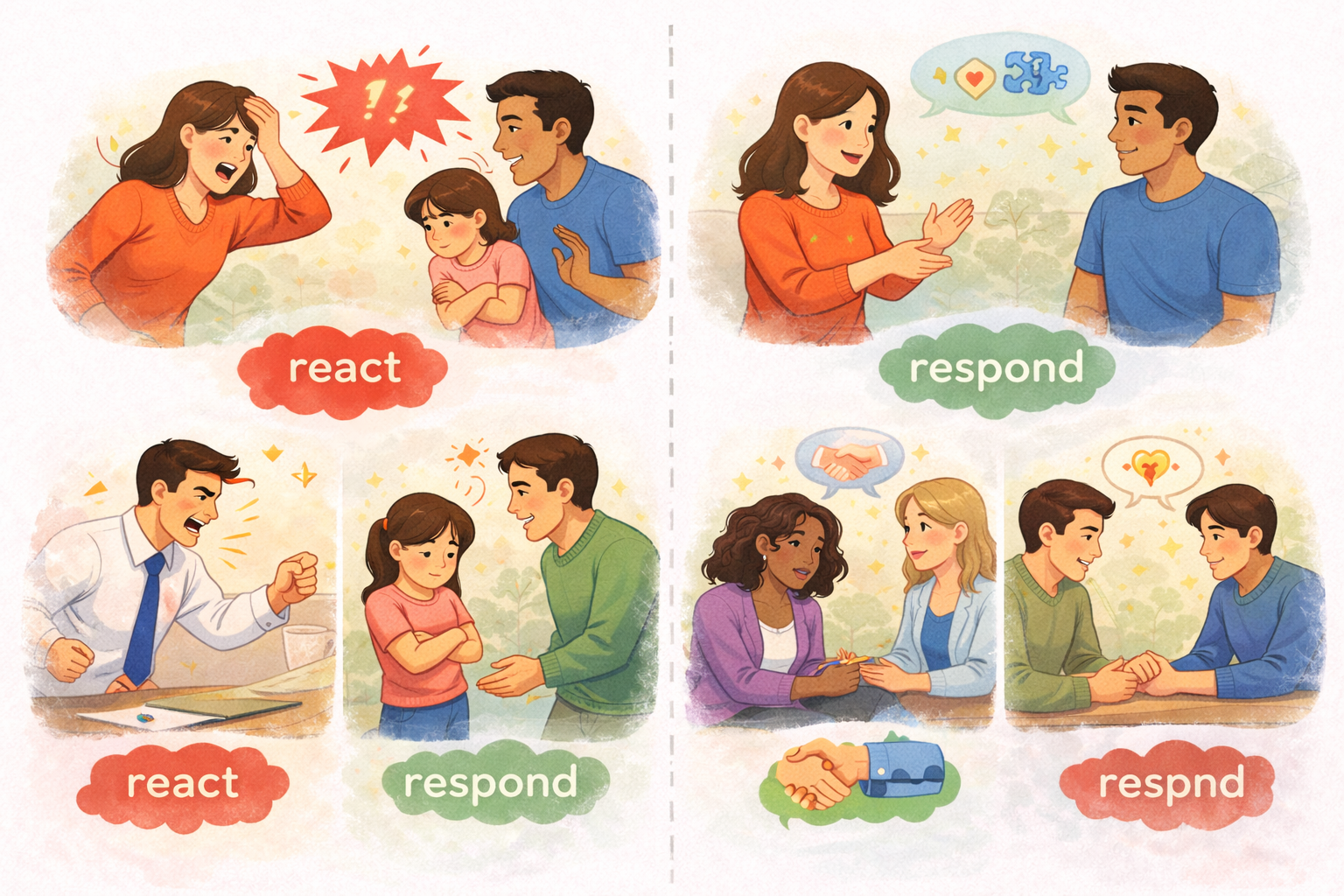
By focusing on your experience rather than blame, you invite the other person—whether a spouse or a teenager—into a collaborative headspace rather than a defensive one. For more strategies on staying grounded, see how to respond instead of react.
Common myths about being assertive
Many caregivers shy away from assertiveness because they misunderstand what it actually is. One common myth is that assertive people are selfish. In reality, assertiveness is the ultimate act of respect for both parties because it removes the guesswork and the "mind-reading" that often leads to resentment. Another myth is that aggression shows strength. On the contrary, emotional regulation is the true marker of strength. Anyone can yell; it takes significant mental fortitude to remain calm and clear under pressure.
Finally, many believe that staying silent is the best way to avoid conflict. However, silence is often just "passive" communication. While it avoids a fight in the short term, the NIH notes that chronic suppression of needs leads to resentment and can even manifest as physical stress symptoms. Assertiveness is the healthy middle ground between the "explosion" of aggression and the "implosion" of passivity.
When to seek extra support
Practicing assertiveness is a skill developed over time, much like a muscle. Start with low-stakes situations, like expressing a preference for dinner or asking for a few minutes of quiet, and build your confidence from there. However, there are times when communication patterns feel too entrenched to change alone. If you find that your interactions frequently escalate into shouting, if there is a cycle of "walking on eggshells," or if you feel unsafe expressing your needs, professional guidance can help. Couples therapy or individual counseling can provide a safe space to deconstruct these patterns and learn new tools for connection and the role of empathy in relationships.
Bottom line: The difference between assertive and aggressive communication lies in your intention and your respect for boundaries. While aggression prioritizes control, assertiveness prioritizes clarity and connection. By choosing to be assertive, you protect your own emotional wellbeing while fostering a home environment built on trust rather than tension.
This article is for general wellbeing information and is not medical advice. If you are in crisis in the US, call or text 988.
For people who care too much
A five-minute refresh, every day.
If this gave you a moment of calm, MindBloom Pro sends ten small positive things to your dashboard each morning — chosen for the family life you're actually living.

Discussion
Comments
Sign in to join the conversation.
Sign inLoading comments…