


Table of contents16 sections · tap to expandShowHide
Meditation was once viewed as a purely spiritual or philosophical practice, but modern neuroscience has radically changed that perception. Today, meditation is one of the most studied mental practices in psychology and brain science. Research from Harvard Medical School, the National Institutes of Health, the American Psychological Association, and Stanford University shows that consistent meditation practice leads to measurable changes in brain structure, function, and emotional regulation.
Rather than “emptying the mind,” meditation trains attention, awareness, and emotional balance. Over time, this training reshapes how the brain responds to stress, processes emotion, and maintains focus.
If you are new to meditation, you may find this foundational guide helpful:
What Is Mindfulness and How to Start?
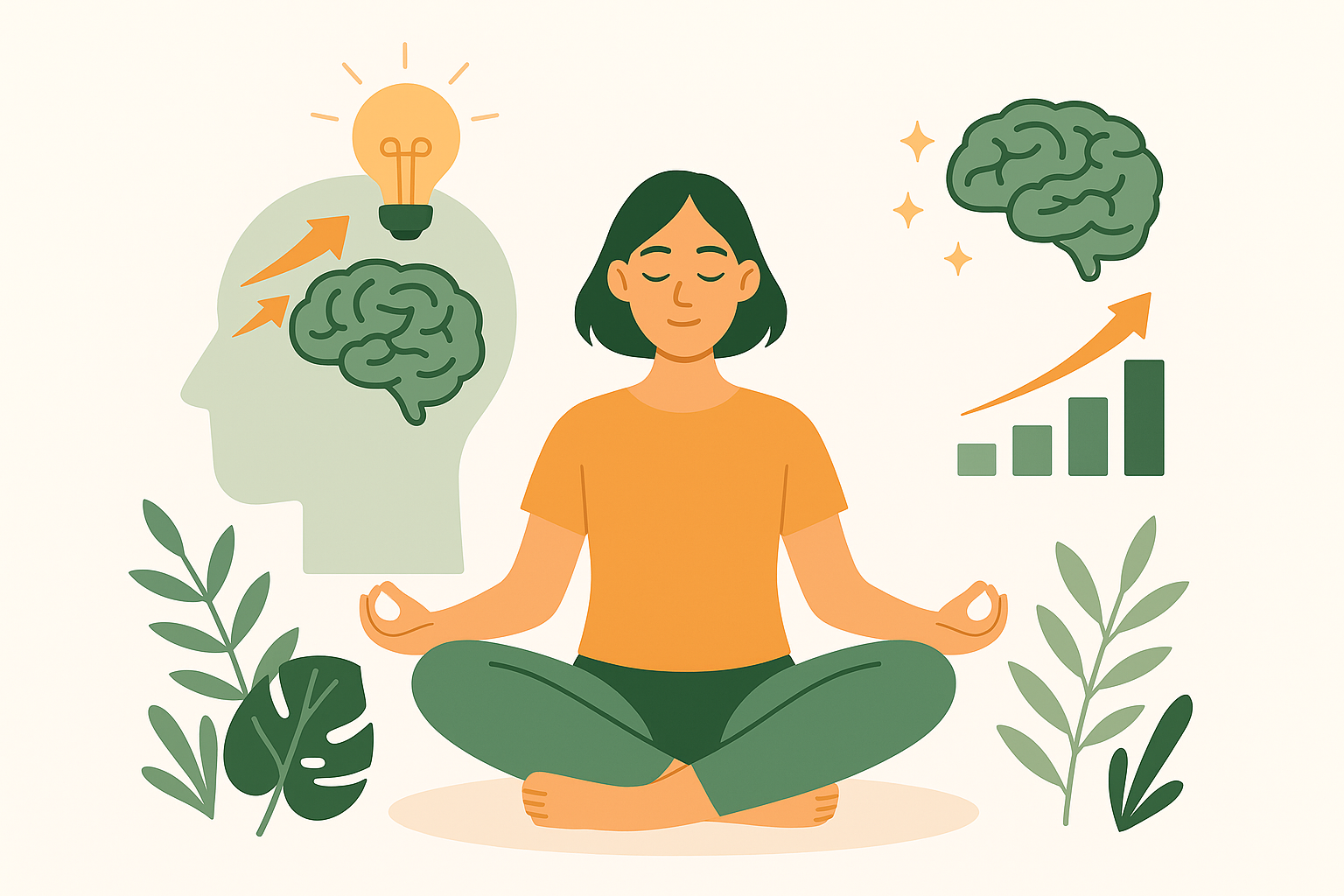
Neuroplasticity: How Meditation Changes the Brain
The brain is not fixed. Neuroplasticity refers to the brain’s ability to reorganize itself by forming new neural connections throughout life. Meditation takes advantage of this ability.
Harvard researchers using MRI scans found that participants who practiced mindfulness meditation for eight weeks showed increased gray matter density in brain regions associated with learning, memory, emotional regulation, and perspective-taking.
At the same time, decreased gray matter density was observed in the amygdala—the brain’s fear and stress center.
These findings confirm that meditation doesn’t just change how you feel—it changes how your brain is wired.
The Prefrontal Cortex: Strengthening Focus and Self-Control
The prefrontal cortex is responsible for attention, decision-making, impulse control, and emotional regulation. This region is often underactive during stress and overactive multitasking.
Stanford neuroscience studies show that meditation increases activation and connectivity in the prefrontal cortex. This leads to:
- improved focus
- better emotional regulation
- stronger self-control
- clearer decision-making
This explains why meditation supports both mental clarity and disciplined behavior.
Related reading:
The Science of Willpower
The Amygdala: Reducing Stress and Fear Responses
The amygdala plays a key role in detecting threats and triggering the stress response. Chronic stress causes the amygdala to become overactive, leading to anxiety and emotional reactivity.
Research from Harvard and the NIH shows that regular meditation reduces amygdala activation. This leads to:
- lower stress reactivity
- reduced anxiety
- faster emotional recovery
Meditation doesn’t eliminate stress—it changes how the brain responds to it.
The Default Mode Network and Overthinking
The default mode network (DMN) is a brain network associated with mind-wandering, self-referential thinking, and rumination. When the DMN is overactive, people experience overthinking and mental fatigue.
Stanford research shows that meditation reduces DMN activity, particularly in areas linked to self-criticism and repetitive thought loops.
This explains why meditation is effective for managing overthinking.
If this is a challenge for you, explore:
The Psychology of Overthinking — And How to Manage It
How Meditation Affects Emotional Regulation
Emotional regulation is the brain’s ability to experience emotions without becoming overwhelmed or reactive. Meditation strengthens the connection between the prefrontal cortex and the limbic system.
The APA reports that meditation improves emotional awareness, allowing people to recognize emotions earlier and respond more skillfully.
This results in:
- greater emotional balance
- reduced impulsive reactions
- increased resilience
For practical tools, see:
How to Respond Instead of React
Meditation and Stress Hormones
Stress activates the hypothalamic-pituitary-adrenal (HPA) axis, increasing cortisol levels. Chronic cortisol elevation harms memory, mood, and immune function.
NIH studies show that meditation lowers baseline cortisol levels and improves stress recovery.
This is one reason meditation supports long-term physical and mental health.
Meditation and Attention Networks
Attention is controlled by multiple brain networks. Meditation strengthens these networks by training sustained focus and awareness.
Stanford research shows improved attentional stability in meditators, making it easier to maintain focus during complex tasks.
If attention and productivity are goals for you, see:
How to Design a Distraction-Free Work Day
Different Meditation Styles and Brain Effects
Not all meditation styles affect the brain in the same way.
- Focused attention meditation: strengthens concentration and attentional control
- Body scan meditation: enhances interoceptive awareness and stress regulation
- Loving-kindness meditation: increases empathy and social connection
- Open monitoring meditation: reduces reactivity and enhances awareness
Explore one style in depth:
Body Scan Meditation Explained
How Long Does It Take for Brain Changes to Occur?
Research shows that measurable brain changes can occur within eight weeks of consistent meditation practice. However, benefits continue to deepen over time.
Consistency matters more than duration. Even 5–10 minutes per day can create meaningful changes.
Meditation and Mental Clarity
By calming the nervous system and strengthening attentional control, meditation supports mental clarity.
This is why meditation is often included in morning routines for focus and productivity.
Related reading:
Mental Clarity Morning Routine
Meditation and Sleep Quality
Meditation improves sleep by reducing physiological arousal and mental chatter. NIH research shows that mindfulness-based practices improve sleep onset and quality.
For sleep support, see:
Sleep Hygiene Tips for a More Restful Night
Common Misconceptions About Meditation and the Brain
- Meditation stops thoughts: false—thoughts continue, but reactivity decreases
- Benefits are placebo: false—brain imaging confirms structural changes
- You must meditate for hours: false—short, consistent practice is effective
How to Support Brain Changes Through Practice
To maximize benefits:
- practice consistently
- start with short sessions
- choose a style that fits you
- pair meditation with breath awareness
Breath-based grounding pairs well with meditation:
Using Breath to Anchor the Mind
Meditation as Mental Training
Meditation is best understood as mental training rather than relaxation alone. Like physical exercise strengthens muscles, meditation strengthens attention, emotional regulation, and resilience.
These changes accumulate gradually through practice.
Who Benefits Most from Meditation?
Meditation benefits people experiencing:
- chronic stress
- anxiety
- mental fatigue
- difficulty focusing
- emotional reactivity
Because meditation works through neuroplasticity, it supports long-term mental wellbeing.
Final Thoughts
The science behind meditation is clear: consistent practice reshapes the brain in measurable, meaningful ways. Meditation strengthens attention, calms stress responses, improves emotional regulation, and enhances mental clarity.
Rather than changing who you are, meditation changes how your brain responds to experience.
When practiced regularly, meditation becomes not just a technique, but a foundation for mental balance and resilience.
More science-backed mindfulness resources from MindBloomDaily:
Guided vs. Silent Meditation: Which Is Best?
Gratitude Practice and Your Brain
For people who care too much
A five-minute refresh, every day.
If this gave you a moment of calm, MindBloom Pro sends ten small positive things to your dashboard each morning — chosen for the family life you're actually living.

Discussion
Comments
Sign in to join the conversation.
Sign inLoading comments…