


Table of contents21 sections · tap to expandShowHide
In today’s fast-paced world, multitasking is often seen as a badge of honor. Many people feel they must juggle several tasks at once to keep up with modern demands. But research from institutions like Stanford University, Harvard Medical School, and the American Psychological Association reveals a very different truth: the brain is not wired to multitask. Instead, switching between tasks drains productivity, weakens focus, and increases stress.
Single-tasking—the practice of dedicating full attention to one activity at a time—is not only more efficient but also better for mental clarity, emotional well-being, and long-term cognitive health. This article explores why single-tasking is more powerful than multitasking, supported by science and practical strategies for daily life.
Why Multitasking Feels Productive (But Isn’t)
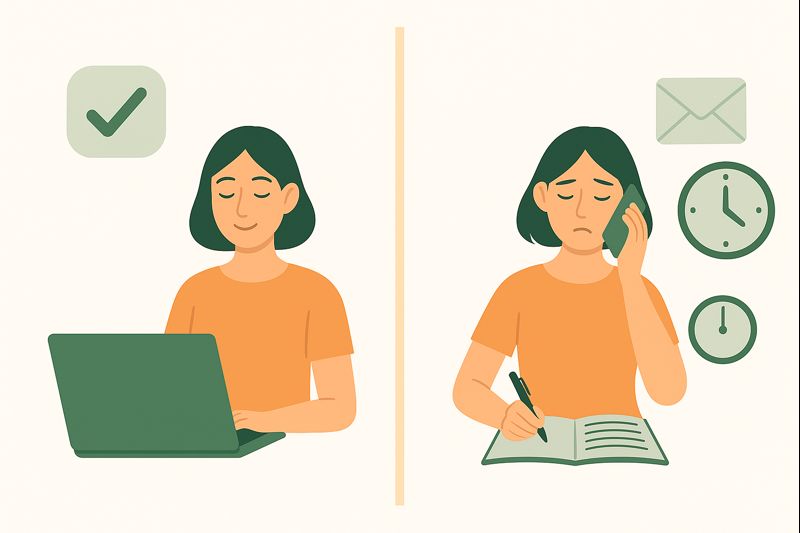
People often multitask because it gives the illusion of efficiency. You feel busy, stimulated, and in motion. But neuroscientists emphasize that multitasking is actually “task switching”—moving your focus rapidly between tasks—not doing tasks simultaneously.
According to Stanford researchers, heavy multitaskers perform worse on attention, memory, and information processing than people who focus on one task at a time. The brain loses momentum every time it switches, making work slower and less accurate.
Multitasking creates:
- Higher stress levels
- More mistakes
- Lower information retention
- Reduced creativity
- Constant mental fatigue
If you’re trying to improve mental clarity, you may also enjoy: 10 Daily Habits That May Support Mental Clarity.
The Cost of Task Switching
Harvard research highlights that each time the brain switches tasks, it requires a cognitive reset—a moment where the brain must reorient to the new task. This transition burns mental energy and increases the time needed to complete tasks.
Even small interruptions, such as checking a notification or email, can derail focus. Studies from the APA show it can take the brain up to 20 minutes to return to full concentration after a distraction.
Task switching leads to:
- Mental exhaustion
- Slower completion rates
- Reduced accuracy in tasks
- Increased stress and frustration
If notifications are a major source of interruption, explore: How Notifications Fragment Your Focus.
The Benefits of Single-Tasking
Single-tasking works with your brain’s natural structure, not against it. When you dedicate full attention to one task, your brain enters a more efficient state where clarity, creativity, and performance peak.
Research-backed benefits include:
1. Better Productivity
Focusing on one task increases output quality and reduces overall completion time. Studies from Stanford show that single-taskers perform tasks more accurately and efficiently than multitaskers.
2. Improved Memory and Learning
When the brain is not interrupted, it consolidates information more effectively. According to NIH research, sustained attention improves long-term memory formation.
3. Reduced Stress
Multitasking overstimulates the brain, increasing cortisol levels. Single-tasking lowers mental pressure and supports emotional stability.
4. Enhanced Creativity
Creativity thrives when the mind has space to explore ideas deeply. Multitasking fractures attention, while single-tasking strengthens creative flow.
5. Higher Quality Work
Deep focus produces more thoughtful, precise results. This is especially valuable for writing, coding, design, or any task requiring accuracy.
If you’re trying to stay more concentrated throughout the day, check out: Creating a Personal Focus System.
Why the Brain Prefers Single-Tasking
Neuroscience reveals that the brain has a limited capacity for processing information at once. When multitasking, you divide this capacity, weakening performance across all tasks.
Key brain science findings include:
- The prefrontal cortex handles attention and cannot fully focus on two tasks at once.
- The brain must “reset” after each switch, reducing efficiency.
- Dopamine spikes from task switching create an addictive cycle of distraction.
Stanford studies show that chronic multitaskers struggle to filter irrelevant information, making it harder to concentrate even when distractions aren’t present.
Single-Tasking Techniques That Work
Single-tasking is a skill that can be trained. The more you practice, the easier it becomes to stay deeply focused.
1. The Pomodoro Method
Work for 25 minutes, then take a 5-minute break. This structure helps the brain sustain attention without burnout.
Why it works:
- Creates predictable focus intervals
- Reduces mental fatigue
- Trains consistency
For additional consistency tools, see: The 2-Minute Rule: Start Small, Stay Consistent.
2. Time Blocking
Assign specific blocks of time to individual tasks. This helps maintain structure and reduces task overlap.
Benefits include:
- Clear boundaries
- Better planning
- Less overwhelm
3. Minimize Digital Distractions
Turn off notifications, close unnecessary tabs, and use distraction blockers when needed. Harvard research shows that even silent notifications weaken focus significantly.
If digital overwhelm is a challenge, explore: Apps That Help You Focus, Not Distract.
4. Prioritize Your Top Task
Begin each day by choosing one “most important task” (MIT). This anchors your focus and prevents scattered effort.
5. Create a Distraction-Free Workspace
A clear environment supports a clear mind. Physical clutter increases cognitive load, making concentration more difficult.
For more on this topic, read: How Decluttering Your Space Affects Your Mind.
6. Practice Mindful Refocusing
Your mind will wander—this is normal. What matters is gently bringing it back to the current task without judgment. This strengthens your attention muscle over time.
Try pairing this with simple breathing, like in: How Deep Breathing Can Help Calm the Mind.
The Emotional Benefits of Single-Tasking
Beyond productivity, single-tasking deeply improves emotional wellness. When you focus fully, your nervous system remains calmer, and your mind feels more grounded.
Emotional benefits include:
- Feeling less overwhelmed
- Greater enjoyment of daily activities
- Improved confidence and sense of mastery
- Deeper engagement with people and tasks
Single-tasking is also linked to improved mindfulness and self-awareness, helping you stay present rather than scattered.
Why Multitasking Feels Mentally Draining
The brain burns more energy when switching tasks because it must constantly reconfigure attention. This leads to:
- Decision fatigue
- Irritability
- Mental exhaustion
- Inconsistent performance
APA reports that multitasking increases stress hormones and decreases emotional regulation, making it harder to stay calm under pressure.
Single-Tasking in Daily Life
You can practice single-tasking during simple activities:
- Eat without checking your phone.
- Walk without listening to podcasts.
- Work on one browser tab at a time.
- Give full attention during conversations.
These small habits create more mental spaciousness and strengthen attention skills.
For deeper presence, explore: What Is Mindfulness and How to Start?.
How Single-Tasking Improves Work and Creativity
Professionals who consistently single-task experience better performance, higher-quality work, and more creative breakthroughs. Creativity requires uninterrupted thought and mental spaciousness. Multitasking fractures this process.
Stanford research shows that deep attention allows for stronger connections between ideas, leading to better problem-solving and innovation.
Final Thoughts
Single-tasking is not a step backward—it’s a return to how the brain works best. When you focus on one task at a time, you protect your mental energy, strengthen your concentration, and create better work with less stress.
Multitasking overstimulates the mind, but single-tasking restores clarity. With practice, you can train your brain to stay present, productive, and emotionally balanced.
More Focus & Productivity Resources:
Time Management Tips That Actually Work
How to Design a Distraction-Free Work Day
For people who care too much
A five-minute refresh, every day.
If this gave you a moment of calm, MindBloom Pro sends ten small positive things to your dashboard each morning — chosen for the family life you're actually living.



Discussion
Comments
Sign in to join the conversation.
Sign inLoading comments…